Most job seekers send the same CV everywhere. It feels efficient. It's also why response rates stay below 5%.
A tailored CV is one that's been rewritten to mirror the specific role you're applying for — the keywords, the emphasis, the order of your experience. It's not about hiding parts of your history. It's about putting the relevant parts first.
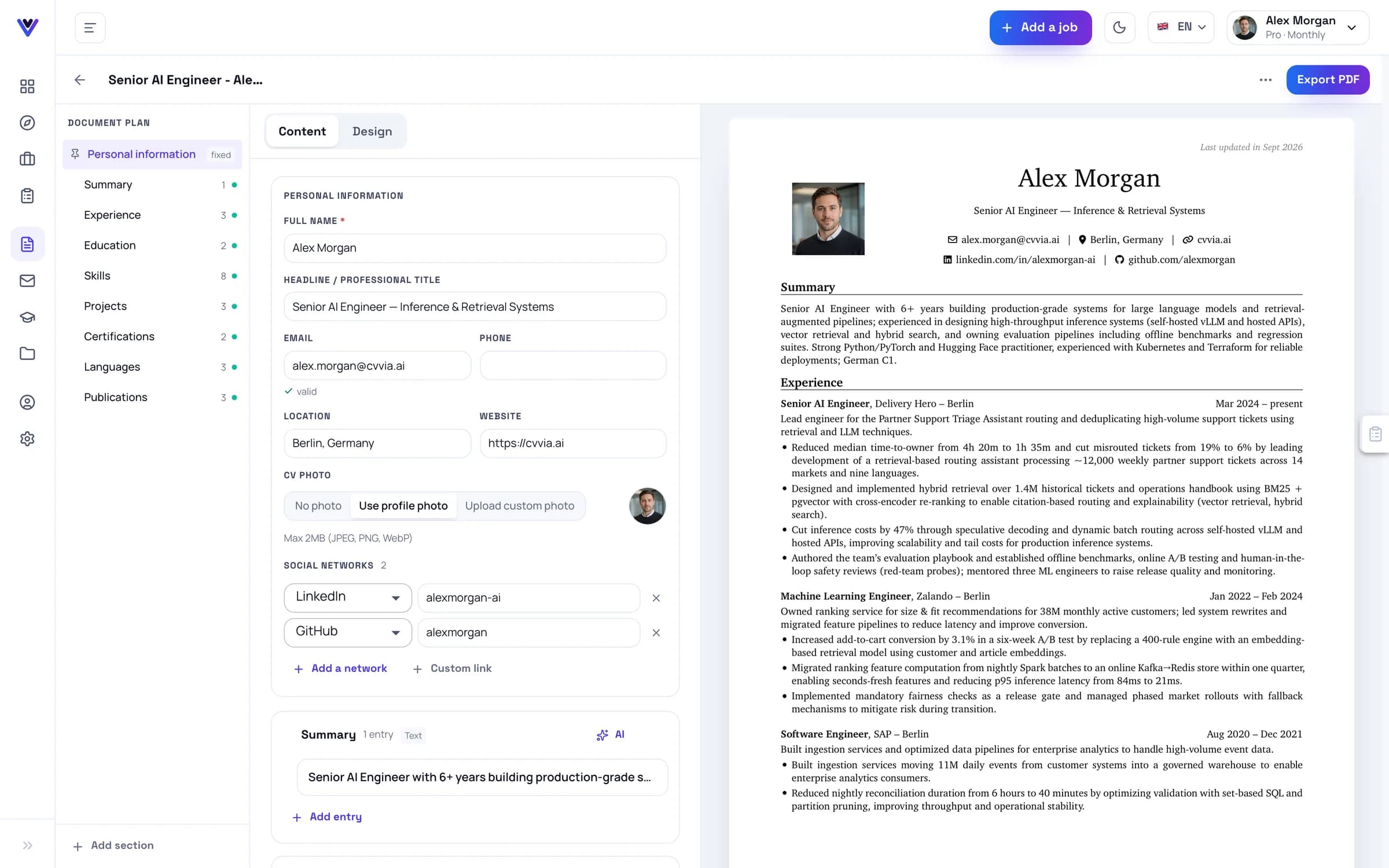
This is the framework we use inside CVVia to generate every tailored CV in about 90 seconds. You can do it manually too — it just takes longer.
Why tailoring matters in 2026
Two things changed in the last decade:
- Applicant Tracking Systems (ATS) parse every CV before a human sees it. Most filter by keyword match — if the job posting says "Postgres" and your CV says "PostgreSQL", that's a mismatch (yes, really, depending on the system).
- Recruiters skim in seconds. Studies repeatedly show 6–8 seconds per CV on the first pass. They're scanning for the 3–5 phrases the hiring manager flagged as must-haves.
A generic CV optimized for "you in general" doesn't survive either filter. A tailored CV — even a slightly tailored one — passes both.
The 4-step tailoring framework
Step 1 — Extract the job's priorities
Read the job posting twice. The first read is comprehension. The second read, mark:
- Must-have skills (usually the first 3–5 bullets, or anything mentioned twice)
- Tools / technologies (specific product names: Figma, Snowflake, Salesforce, Postgres)
- Seniority markers (years of experience, scope phrases like "lead a team of", "own the roadmap for")
- Implicit values (does it say "fast-paced" or "thoughtful"? "ship daily" or "ship carefully"?)
That's your target.
Step 2 — Reorder your existing experience
You don't add fake jobs. You reorder what's already there. For each role on your CV:
- Move bullets that match the target to the top of that role's bullet list.
- Demote or remove bullets that aren't relevant to this specific job (they can come back for the next application).
- Keep your most recent role as the most-detailed entry — recruiters expect this.
Step 3 — Rewrite the summary
Your CV summary (the 2–3 line block under your name) is the most-read part of the document. Generic summaries waste it.
A tailored summary mirrors the job's vocabulary. If the posting is for "Product Engineer focused on growth experimentation," your summary should contain "product engineer," "growth," and "experimentation" — using those exact phrases.
Don't lie. Don't claim experience you don't have. But if you've shipped A/B tests at any point, that's "growth experimentation." Frame it accordingly.
Step 4 — Mirror the keywords (carefully)
ATS systems do keyword matching. Tailor your CV by:
- Using the exact tools named in the posting (Postgres vs PostgreSQL, React vs ReactJS — match the posting's spelling).
- Including soft-skill phrases the posting uses ("cross-functional collaboration," "stakeholder management," "data-driven decision-making").
- Avoiding synonyms when the posting uses a specific term. "Built" instead of "developed" if the posting says "built."
The line you don't cross: keyword stuffing. A bullet that says "led product strategy growth experimentation A/B testing data-driven cross-functional" is a red flag for both ATS systems and humans. Use keywords in natural sentences.
Common mistakes to avoid
- Tailoring the summary but forgetting the rest. ATS scans the whole document. Match keywords throughout.
- Using a fancy two-column layout. Most ATS systems can't parse multi-column CVs reliably. Single column, clean structure.
- Adding a photo for US/UK roles. US, UK, Canada hiring conventions discourage CV photos for legal reasons (anti-discrimination). Germany, Austria, and most of continental Europe expect them.
- Listing every skill you've ever touched. Skills you can't defend in an interview hurt more than help. Keep skill lists tight and relevant.
- Generic action verbs. "Responsible for" is the weakest opener. "Led," "shipped," "owned," "scaled," "rebuilt" are stronger.
Where AI helps — and where it hurts
AI is excellent at:
- Rewriting a bullet point to match a different domain's vocabulary.
- Extracting the must-haves from a job posting you've already read.
- ATS-checking your CV against the posting before submitting.
- Drafting a tailored summary you then edit.
AI is bad at:
- Inventing experience you don't have. Don't let it.
- Replacing your voice. Hiring managers notice CV-shaped prose from a chatbot. Edit AI drafts so they sound like you.
- Choosing what to leave out. Judgment about which experiences to demote belongs to you — you know the human context.
The right model: AI drafts, you decide. That's how CVVia's editor works — every section is editable, AI suggestions are opt-in, and you stay in control of the final document.
FAQ
How long should a tailored CV be? One page for 0–5 years of experience, two pages for 5–15 years, up to three for senior/executive roles. Don't shrink the font to fit — cut content instead.
Should I create a new CV file for every job? Yes. Save it with the role and company in the filename ("alex-morgan-cv-product-engineer-stripe.pdf") so you can find it later if they call back.
How tailored is "tailored enough"? If a recruiter reads the first half-page and the words from the job posting are visible there, you've done enough. Don't aim for perfection; aim for relevance.
Will ATS systems reject me for keyword stuffing? Modern ATS systems are getting smarter about this. The bigger risk is the human recruiter rejecting a CV that reads like a robot wrote it. Natural sentences with real keywords > keyword soup.
Is tailoring worth it for high-volume applications? Yes — but use tools. Manually tailoring 30 CVs per week is unsustainable. AI tools that read the job posting and reorder your base CV in 90 seconds make the volume work. That's the problem CVVia exists to solve.
Want to tailor in 90 seconds instead of 90 minutes? Try CVVia free → — no credit card required, three tailored CVs per month on the free plan.
Filed under
- cv
- job-search
- ats
- tailoring